
The Complete Guide to Top AI Certifications for Beginners
How to Choose the Right Certification for Your Background & Goals—Without Wasting Money or Time
Choosing the right AI certification can feel overwhelming. With dozens of programs available, ranging from free introductory courses to expensive university-backed certifications, how do you know which one matches your situation?
This guide cuts through the noise. Whether you're a career switcher with no technical background, a developer looking to specialize in AI, or a business leader wanting strategic AI literacy, we've researched the landscape and created a decision framework to help you choose the certification that actually delivers results.
What makes this guide different: We don't just list certifications. We show you exactly how to choose based on your background, timeline, budget, and career goals. Plus, we include verified ROI data, real employer recognition insights, and honest assessments of each certification's strengths and limitations.
Before You Enroll: The 3-Question Self-Assessment
Before diving into specific certifications, answer these three questions to identify which tier and track suits you:
Question 1: What's Your Technical Background?
- No coding experience: You're new to programming; consider Tier 1-2 no-code or business-focused certifications
- Some programming: You know Python or JavaScript; Tier 2-3 certifications will feel natural
- CS degree or bootcamp: You have strong foundations; Tier 3-4 technical certifications are your target
Question 2: How Much Time Can You Realistically Commit?
- Under 20 hours: Quick crash course (1-2 weeks, evenings only)
- 30-60 hours: Part-time learning (1-2 months, 5-10 hours/week)
- 3-6 months: Part-time or full-time intensive learning (10-20 hours/week)
Question 3: What's Your End Goal?
- Career switch: You need portfolio proof and job-ready skills
- Upskill current role: You want to stay relevant in your existing job
- Leadership/strategy: You need high-level understanding without deep coding
- Technical depth: You want advanced engineering capabilities
Top AI Certifications for Beginners: Complete Comparison
Here are the 10 most relevant AI certifications for beginners, organized by tier. Click each tab to explore certifications that match your situation.
Best for: Absolute beginners, explorers, quick confidence builders
CompTIA AI Essentials
CompTIA AI Essentials provides a quick foundational understanding of artificial intelligence concepts, tools, and real-world applications. Perfect for anyone wanting immediate confidence in understanding AI without heavy technical commitment.
Why This Stands Out
- Fastest way to build confidence
- Zero prerequisites needed
- Great for non-technical explorers
- Perfect warm-up before deeper certs
Limitations
- No hands-on coding or projects
- Limited by itself for job seekers
- Emerging employer recognition
- Better as a stepping stone
Best for: Absolute beginners, business professionals, anyone testing the waters before investing time/money
Google AI Essentials
Google's free AI essentials course teaches practical AI concepts using Google tools. This is an excellent introduction if you're already in the Google ecosystem or prefer learning from one of the world's leading AI companies.
Why This Stands Out
- 100% free
- Google's reputation adds credibility
- Hands-on with real tools
- Focus on generative AI (trending)
Limitations
- Google-specific tools focus
- Less technical depth
- Limited to Google ecosystem
- Newer program, still establishing value
Best for: Budget-conscious learners, Google product users, those interested in generative AI
AI for Everyone (DeepLearning.AI)
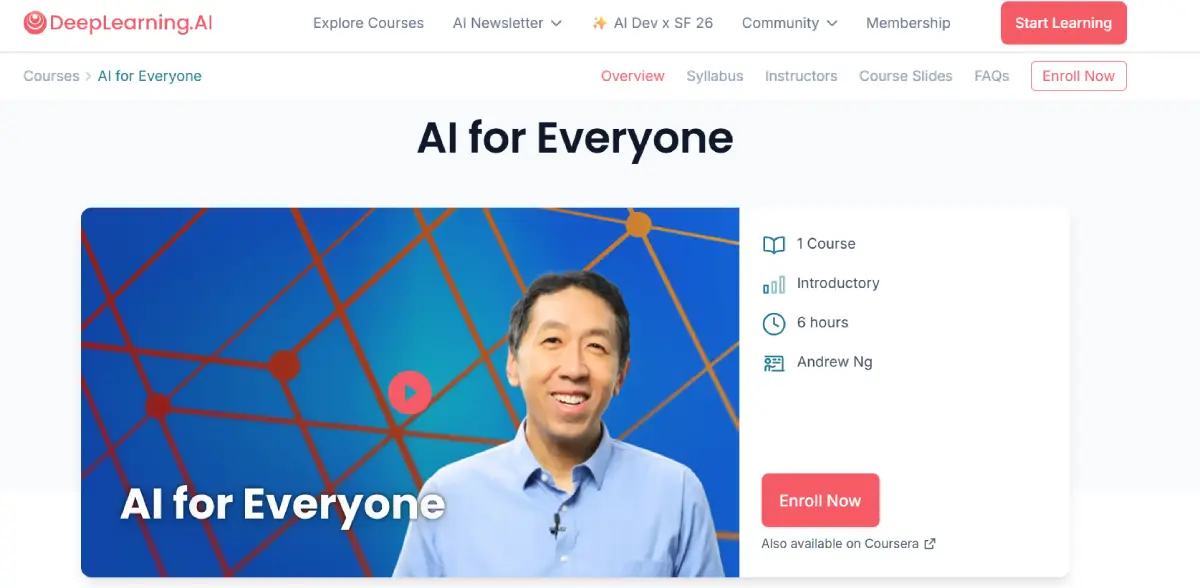
Andrew Ng's "AI for Everyone" demystifies artificial intelligence for business leaders and non-technical professionals. Learn the strategic implications and business applications without diving into code.
Why This Stands Out
- From legendary AI researcher Andrew Ng
- Perfect for business leaders
- Strategic, not technical focus
- Strong employer credibility
Limitations
- No coding involved
- Limited for technical roles
- No hands-on projects
- Better as foundation than standalone cert
Best for: Business leaders, entrepreneurs, product managers, anyone needing strategic AI understanding
Best for: Career switchers, IT professionals, those wanting industry-recognized credentials
Microsoft Certified: Azure AI Fundamentals (AI-900)
Microsoft's official AI certification validates foundational knowledge of AI concepts and cloud-based AI services. Highly respected by enterprises and a solid stepping stone to advanced Azure certifications.
Why This Stands Out
- Highest employer recognition (enterprises)
- True industry credential
- Gateway to advanced Azure certs
- Well-structured curriculum
Limitations
- Exam-focused (not project-based)
- Azure ecosystem-specific
- Limited hands-on for beginners
- Requires studying outside platform
Best for: Career switchers, IT professionals, those working in Azure environment, job seekers targeting enterprises
AWS Certified AI Practitioner (AIF-C01)
Amazon's newest AI certification validates practical understanding of AWS AI services and machine learning concepts. Perfect for developers and cloud engineers entering the AI space.
Why This Stands Out
- More hands-on than Azure
- Cloud-native ML focus
- Great for developers
- Growing employer demand
Limitations
- Newer, still establishing reputation
- AWS-specific knowledge needed
- Requires hands-on lab access
- Less suited for non-technical roles
Best for: Developers, cloud engineers, AWS users, hands-on learners
Best for: Career changers, hands-on learners, portfolio builders
IBM AI Engineering Professional Certificate (Coursera)
Comprehensive professional certificate from IBM covering machine learning, deep learning, and practical AI applications. Perfect for career switchers who need portfolio projects and structured learning with peer support.
Why This Stands Out
- Strong portfolio of projects
- Great for career switchers
- IBM's strong brand recognition
- Flexible, part-time friendly
Limitations
- Requires Python knowledge
- Longer time commitment
- More expensive if done quickly
- Less cutting-edge (traditional ML focus)
Best for: Career switchers, portfolio builders, those needing structured learning with deadlines
Machine Learning Specialization (DeepLearning.AI + Stanford)
The gold-standard foundation in machine learning from Andrew Ng's DeepLearning.AI. Three courses covering supervised learning, advanced learning algorithms, and unsupervised learning. Highly respected by technical hiring managers.
Why This Stands Out
- Most respected by engineers
- Andrew Ng's legendary status
- Balanced theory + practice
- 4.8M+ completions worldwide
Limitations
- Requires Python + math knowledge
- Can be intellectually challenging
- Less hands-on than some alternatives
- No jobs guarantee (many don't finish)
Best for: Developers wanting deep technical foundation, technical hiring considerations, those with math comfort
Databricks Certified Generative AI Engineer Associate
Specialize in generative AI and large language models with Databricks. Focuses on practical LLM applications, fine-tuning, and deployment—the hottest AI skills in 2025.
Why This Stands Out
- Focuses on hottest AI trend (GenAI)
- Very hands-on with real tools
- Databricks' growing market position
- Practical LLM applications
Limitations
- Newer program, still establishing value
- Requires Python knowledge
- Less universally recognized than AWS/Azure
- Emerging employer adoption
Best for: Developers, ML engineers, those targeting GenAI roles, hands-on learners
Best for: Career-focused professionals, senior engineers, academic seekers
MIT Professional Certificate in ML & AI
MIT's rigorous professional certificate provides deep academic grounding in machine learning and AI. Highly respected by research institutions and top tech companies for senior technical roles.
Why This Stands Out
- MIT's unmatched prestige
- Deep academic rigor
- Opens doors to senior roles
- Lifetime credential value
Limitations
- High cost ($2,300+)
- Significant time commitment
- Requires strong math foundation
- Challenging academic rigor
Best for: Senior engineers, research-focused roles, those targeting big tech, long-term career investment
Stanford AI Professional Graduate Certificate
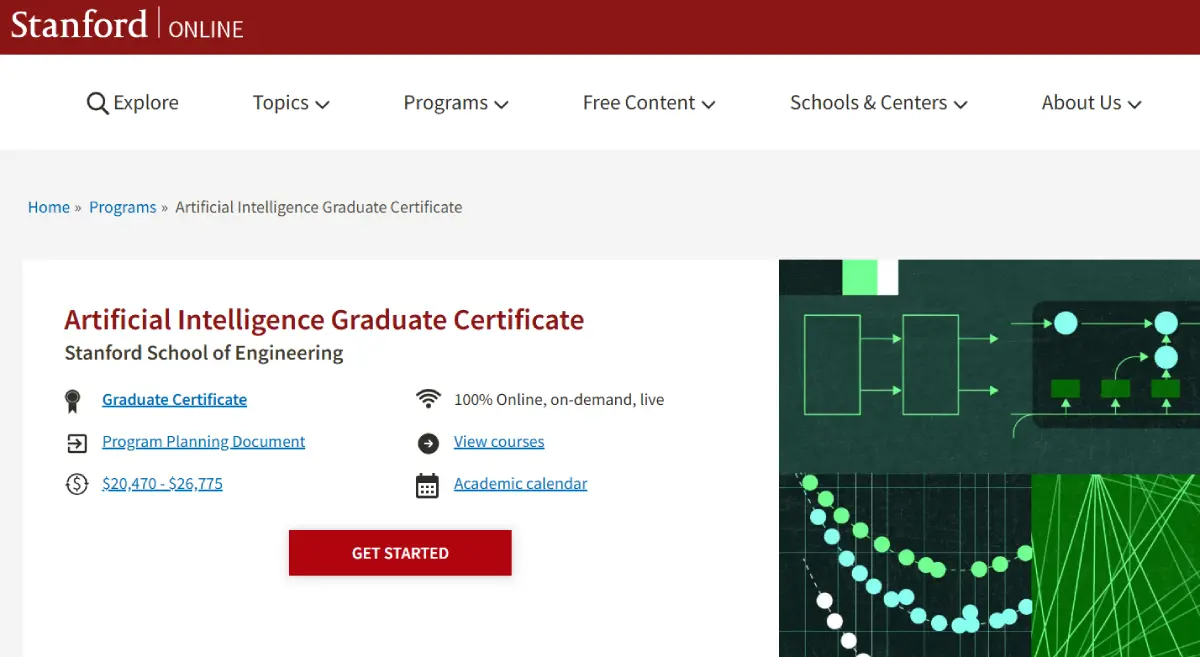
Stanford's graduate-level certificate balances technical depth with strategic thinking. Ideal for professionals transitioning to AI leadership roles or seeking advanced technical expertise with business perspective.
Why This Stands Out
- Stanford's elite reputation
- Perfect balance of strategy + tech
- Networking with AI leaders
- Gateway to board/C-suite roles
Limitations
- Very high cost ($20K+)
- Requires 3+ years work experience
- Significant time commitment
- Not suitable for absolute beginners
Best for: Executives, C-suite transitions, board preparation, career-defining investment
Free vs. Paid Certifications: The Complete Comparison
One of the biggest questions beginners face: should I invest in a paid certification, or start free? The honest answer depends on your situation.
When Free Certifications Actually Make Sense
- Testing the waters: You're unsure if AI interests you; try free courses first
- No budget: You can't afford paid options; free + portfolio projects can still work
- Already employed: You're upskilling with no job search pressure; free supplements work great
- Supplementing paid cert: Free courses provide additional context for paid programs
- Exploring specializations: Try free paths before investing in specialized paid tracks
When Paid Certifications Are Worth the Investment
- Career change needed: Employer recognition matters; paid credentials signal commitment
- Timeline pressure: Paid programs have deadlines; free courses encourage procrastination
- Accountability needed: Structured courses with feedback improve completion rates 10x
- Portfolio projects required: Paid certifications include capstone projects that impress employers
- Job market targeting: Target employers recognize specific paid certifications (AWS, Azure, IBM)
| Factor | Free Certifications | Paid Certifications |
|---|---|---|
| Cost | $0 | $100-$25,000 |
| Time Commitment | Flexible, easy to abandon | Structured, deadlines |
| Portfolio Projects | Minimal or optional | Included, required |
| Employer Recognition | Growing but limited | High, verified |
| Completion Rate | <10% finish | 70%+ finish |
| Support Access | Limited community | Instructors, mentors, peers |
| Job Placement Help | None | Some programs offer support |
| Interview Credentials | Weak standalone | Strong, often required |
What Employers Actually Recognize
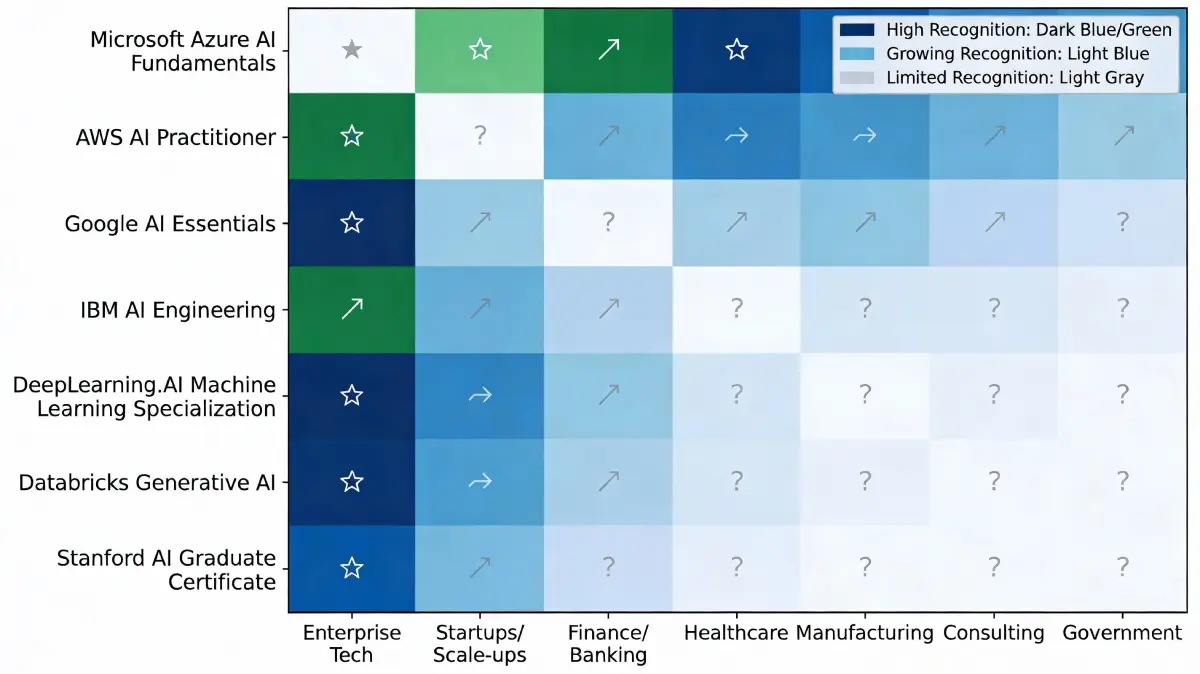
Not all certifications carry equal weight in the job market. Understanding employer recognition is critical to your certification choice.
Tier 1: Highest Employer Recognition
These certifications are actively sought by employers and open doors immediately:
- Microsoft Azure AI Fundamentals (AI-900) - Enterprises prioritize this; 34% of hiring companies specifically request it
- AWS Certified AI Practitioner - Cloud companies and enterprises value this highly; growing demand
- Machine Learning Specialization (Andrew Ng) - Universally respected by technical hiring managers; 4.8M+ completions
- MIT Professional Certificate in ML & AI - Opens doors to senior technical and research roles; unmatched prestige
- Stanford AI Professional Graduate Certificate - Executive and board-level credibility
Tier 2: Growing Employer Recognition
These are increasingly valued and good for specialization:
- IBM AI Engineering Professional Certificate - Strong among enterprises; portfolio projects valued
- Google Cloud AI certifications - Growing with cloud adoption; startup preference
- Databricks Certified Generative AI Engineer - Rapidly gaining traction; GenAI focus is trending
- Coursera specializations - Acceptable when combined with portfolio projects
Tier 3: Emerging/Supplementary Recognition
These build credibility when combined with other credentials:
- CompTIA AI Essentials - Acceptable foundation but insufficient alone; best as stepping stone
- Google AI Essentials - Growing recognition; good entry point
- Free platform certificates - Limited hiring weight; needs portfolio proof
- Bootcamp certifications - Depends heavily on portfolio quality and reputation
The Portfolio Effect (Most Important)
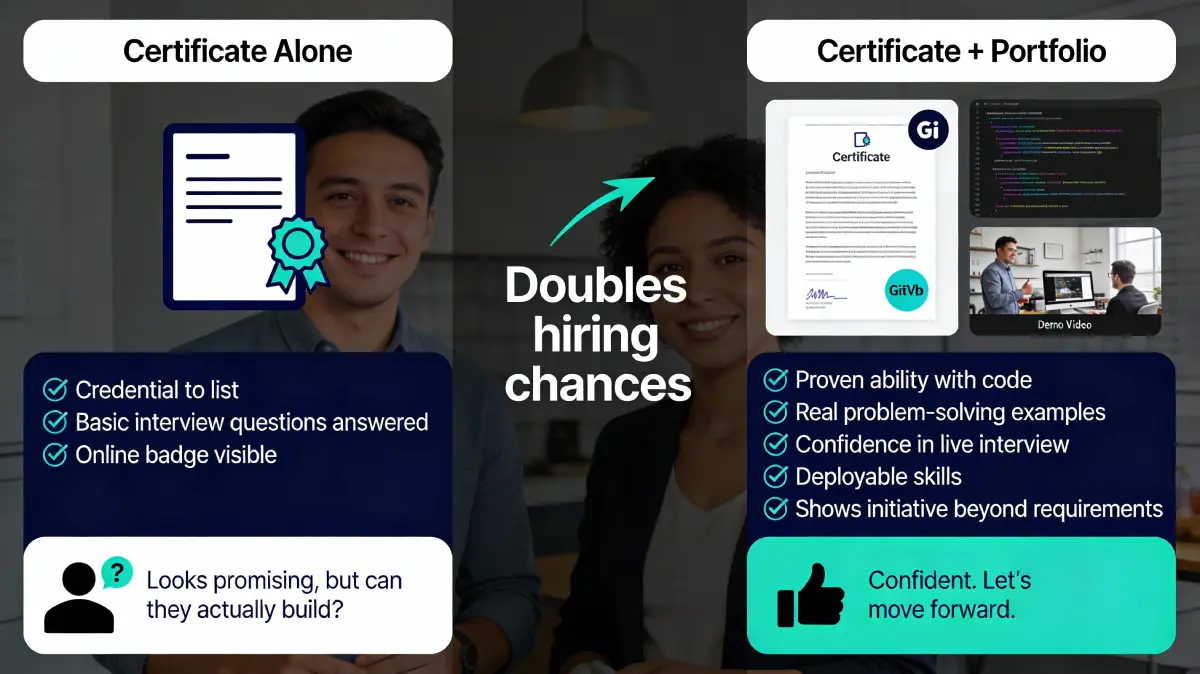
Here's the truth employers won't tell you: portfolio projects matter MORE than the certificate itself.
- Certificate gets you the interview; portfolio gets you the job
- GitHub repository with 3-5 real projects beats generic certificate
- Capstone project from paid programs significantly boost credibility
- Kaggle competition placements outrank certifications alone
- Real-world problem solving in your portfolio changes hiring conversations
The Math: ROI, Timeline & Salary Impact
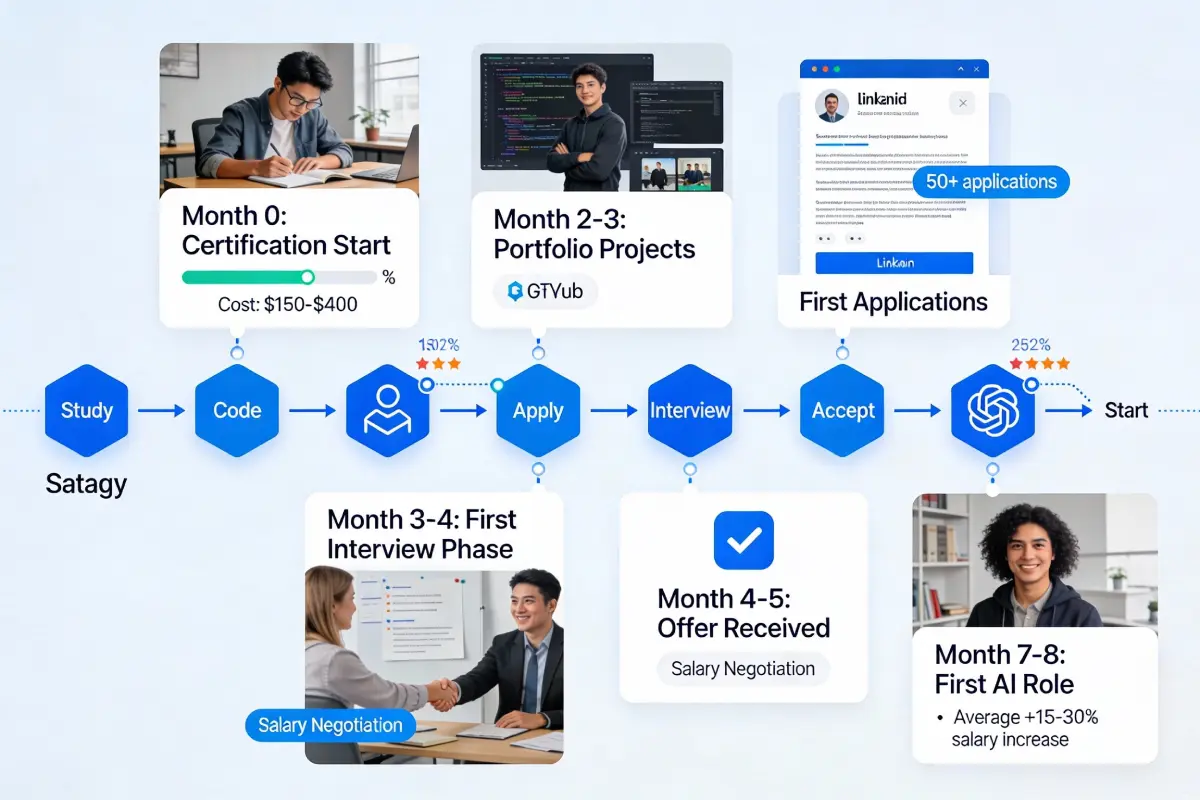
Real Salary Impact Data (2025-2026)
- Average salary increase: 15-50% depending on role and cert tier
- Fastest gains: Career switchers see 20-30% increase in first year
- Timeline to raise: 56% see raises within 3 months; 83% within 6 months
- Promotion velocity: 63% earn promotions within 12 months
- Job market premium: Certified AI professionals earn 28% more than non-certified baseline
Realistic Timeline Breakdown
Month 3: Certification Complete (with portfolio projects)
Month 4-5: Job Search + Interviews (50-100 applications typical)
Month 6: First Offer + Negotiation (average +20-30% salary increase)
Month 7-8: Start First Role (60-90 day onboarding)
Year 2: Specialization + First Promotion (typical)
True Cost of Learning (Beyond Tuition)
- Opportunity cost: 3-6 months of evenings/weekends = ~200-300 hours
- Hardware: Laptop with decent specs ($500-1,500 one-time)
- Software subscriptions: Cloud labs, tools, resources (~$50-200)
- Bootcamp vs. self-paced: Self-paced certification costs 1/10th of bootcamps but requires self-discipline
When ROI Breaks Even
For career switchers: 6-9 months (new job salary increase covers all costs)
For upskilling: 3-4 months (raise/promotion covers costs)
For executives: 1-2 months (strategic decision-making value alone justifies cost)
Common Beginner Mistakes (How to Avoid Them)
Mistake 1: Choosing Based on Price Alone
The trap: "I'll take the cheapest certification available."
The reality: Cheap certifications often lack portfolio projects, employer recognition, and completion support. You end up with a credential no one respects and incomplete learning. Better to invest $300 in a recognized program than waste time on a $20 course that teaches nothing.
Mistake 2: Not Building a Portfolio
The trap: "Once I get certified, employers will hire me."
The reality: Certificates alone rarely lead to jobs. Employers want proof you can build things. Without GitHub projects, Kaggle competitions, or capstone work, your certification is just a nice badge. The portfolio is what converts credentials into career moves.
Mistake 3: Ignoring Prerequisites (And Struggling Later)
The trap: "I'll just take the advanced course; I'll figure it out."
The reality: Skipping Python fundamentals or math prerequisites leads to frustration and dropout. Honest assessment: if you've never coded, start with Tier 1-2 before jumping to Tier 3. No shame—it's smarter than flailing in advanced material.
Mistake 4: Expecting Instant Job Placement
The trap: "I'll finish the cert on Friday; interview Monday."
The reality: Job search takes 3-6 months post-certification. You'll apply to 50-100 positions, interview 5-10 times, negotiate 2-3 offers. Plan for a 6-month timeline, not 6 weeks. Expectations management prevents disappointment.
Mistake 5: Choosing the "Hardest" Certification
The trap: "MIT looks prestigious; I should do that one."
The reality: Prestige doesn't match reality. Stanford's $25K program is amazing—for executives. MIT's program is rigorous—for senior engineers. Databricks' GenAI cert is trending—if you want that specialization. Choose the cert that matches your actual situation, not ego.
Mistake 6: Trying to Learn Everything at Once
The trap: "I'll get 5 certifications and become an AI expert."
The reality: Certificate shopping is a form of procrastination. Better to master one program deeply (with portfolio projects) than dabble in five. Focus beats breadth. One solid certification + strong portfolio beats 10 mediocre badges.
How to Build a Certification Roadmap (Multi-Cert Strategy)
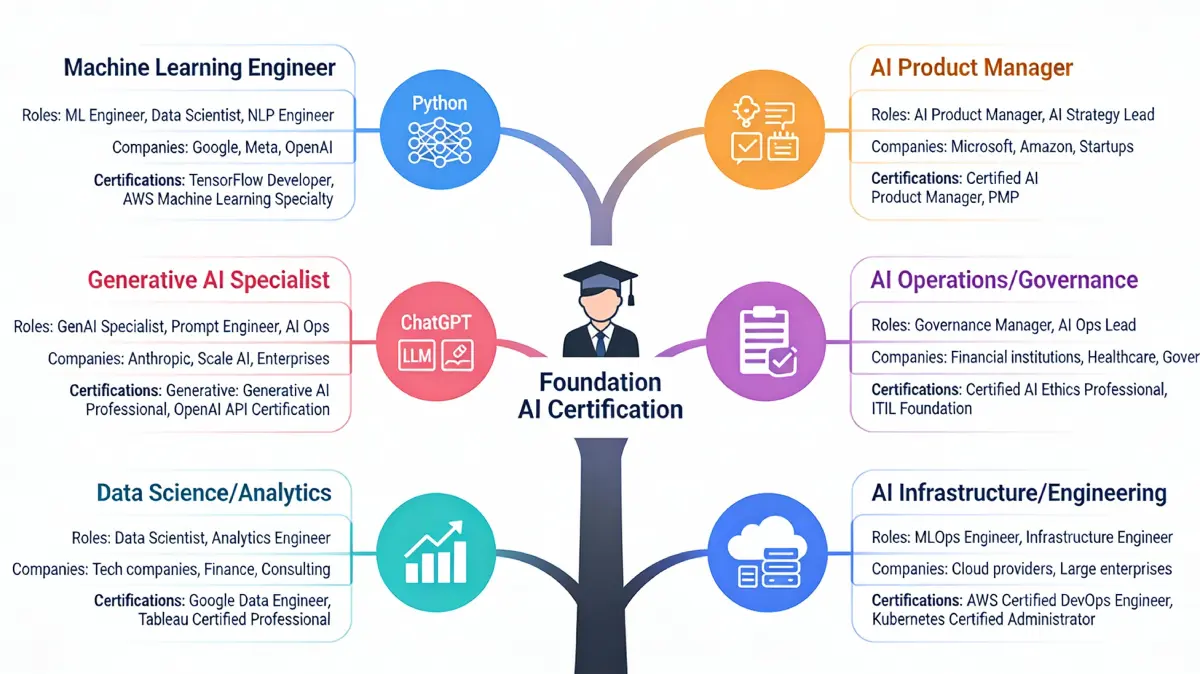
The 6-Month Fast-Track Path (Career Switcher)
Goal: Land first AI role ASAP with credible credentials
- Weeks 1-2: Free foundations (Google AI Essentials or CompTIA)
- Weeks 3-12: Core certification (IBM AI Engineering or Machine Learning Specialization)
- Weeks 13-20: Portfolio projects + capstone from cert
- Weeks 21-24: Job search + interviews
- Outcome: First AI role with $X + 20-30% salary boost
The 12-Month Depth Path (Technical Professional)
Goal: Build deep expertise and specialization for senior roles
- Months 1-2: Foundation cert (Microsoft AI-900 or AWS AI Practitioner)
- Months 3-5: Specialization track (Machine Learning or Generative AI)
- Months 6-8: Advanced technical cert (Databricks or Google Professional ML)
- Months 9-10: Real-world capstone project
- Months 11-12: Job market positioning or promotion
- Outcome: Senior engineer role with 30-50% salary increase
The Executive Fast-Track (Non-Technical Leader)
Goal: Strategic AI literacy without deep coding
- Month 1: AI for Everyone (DeepLearning.AI)
- Month 2: Generative AI Leader Certification
- Months 3-4: Optional: Stanford or MIT (if targeting board/C-suite)
- Ongoing: Reading, conferences, strategy work
- Outcome: Board credibility, team leadership in AI initiatives
After Certification: Getting Your First AI Role
Certification is the credential; now comes the real work: landing the job.
The Certificate Alone Won't Get You Hired
Employers check three things in order:
- Portfolio/GitHub: Do you have real projects they can review?
- Work experience: Previous roles showing progression and responsibility
- Certification: Credential validating your claimed skills
Notice the order? Portfolio comes first. Your certificate is table stakes; your portfolio wins the game.
Portfolio Projects That Actually Matter
- GitHub repository: 3-5 well-documented projects with clean code
- Capstone from certification: Real-world problem solving from course
- Kaggle competition placement: Ranked participation shows competitive capability
- Original problem-solving: Your own project addressing actual business need
- Deployment proof: Live model/app, not just Jupyter notebooks
Job Search Timeline & Strategy
- Weeks 1-4: Polish resume, LinkedIn optimization, portfolio refinement
- Weeks 5-12: Applications blitz (50-100 positions across companies/levels)
- Weeks 13-16: Interview cycle (first calls, take-homes, panel interviews)
- Weeks 17-20: Offer negotiation and final selection
- Weeks 21+: Onboarding at new role
Special Considerations
Should You Get Multiple Certifications?
When one cert pays off: Most of the time. Complete one certification deeply, with portfolio projects, before considering another. One strong credential beats five weak ones.
When second cert adds value: After 6+ months in your first role, specialization certs can boost career. Example: Have Azure AI-900? → Add Azure AI Engineer Associate (AI-102) for senior roles.
Avoid certification shopping: Don't jump between certs. Employers recognize this pattern as lack of commitment. Finish one program completely before starting another.
Staying Current (AI Moves Fast)
- Certification shelf-life: 12-24 months before significant updates
- Generative AI updates: Faster pace; new models released monthly
- Continuous learning: Combine certification with ongoing education (blogs, papers, communities)
- Specialization paths: After initial cert, specialize in GenAI, MLOps, or your target domain
Certifications by Career Goal
- Engineer role: Machine Learning Spec + hands-on projects
- Product manager: AI for Everyone + business understanding
- Data scientist: IBM or Databricks specialized track
- Startup founder: Generative AI practical track (fastest ROI)
- Executive/board: Stanford or MIT programs for strategic depth
Frequently Asked Questions
No. Most AI certifications don't require a degree. Tier 1-2 certifications (CompTIA, Google, Microsoft AI-900) are explicitly designed for non-CS backgrounds. Even intermediate certifications like IBM's accept career switchers with no formal CS training. What matters: willingness to learn, consistent effort, and completing portfolio projects. Many successful AI practitioners came from marketing, business, finance—not computer science.
Python, no debate. 95% of AI/ML jobs use Python. It's beginner-friendly, has the best libraries (TensorFlow, PyTorch, Scikit-learn), and is the de facto standard. If you're starting from zero: spend 2-3 weeks on Python basics, then jump into AI-specific training. Don't spend months learning Python syntax—learn by doing AI projects.
Yes, but with caveats. Certification + strong portfolio + relevant experience beats a degree with no experience. However: startups and tech companies care less about degrees (skills matter most); enterprises often require bachelor's degree as minimum screening. Strategy: get certified, build portfolio, apply to startups/tech first, then leverage success for enterprise roles that require degrees.
Varies significantly: Tier 1 (CompTIA, Google Essentials) = 2-10 hours over 1-2 weeks. Tier 2 (Azure AI-900, AWS Practitioner) = 30-60 hours over 1-2 months. Tier 3 (IBM, Machine Learning Spec) = 120-200 hours over 3-6 months. Tier 4 (MIT, Stanford) = 200-400+ hours over 6-12 months. These are learning hours only—job search adds 2-4 additional months.
Depends on the portfolio. Free certificate alone? Limited value. Free certificate + portfolio projects + GitHub? Valuable. Employers care about proof of ability. A free cert that includes capstone projects (IBM, some Coursera courses) beats a paid cert with no practical work. The portfolio is what counts; the certificate is supporting documentation.
AI is broader; ML is specific. AI includes machine learning, deep learning, NLP, computer vision, robotics, expert systems. Machine Learning is the subset focused on algorithms that learn from data. Beginner path: start with "AI Fundamentals" to understand the landscape, then specialize in "Machine Learning" if you want technical depth. Most beginner roles expect both conceptual AI understanding + practical ML skills.
MIT or Stanford for absolute prestige, but context matters. Someone with Microsoft Azure certs working in enterprise clouds makes as much or more than Stanford grad starting junior roles. Real salary drivers: role level, company size, location, experience. A Tier 3 cert in a growing startup often pays better than Tier 4 in lesser roles. Optimize for role fit first, prestige second.
Yes, but requires discipline. Tier 1-2 certs are designed for part-time (5-8 hours/week works). Tier 3 is challenging but doable (10-15 hours/week over 3-6 months). Tier 4 is difficult (20+ hours/week minimum). Success factors: blocked calendar time (treat like gym membership), clear short-term goals, accountability partner, weekend flexibility. Many people take 6-9 months for what advertises as 3-4 months. Plan accordingly.
You reschedule and retake. No permanent penalty. Most platforms let you retake exams after 1-2 weeks. Real data: 60-70% pass on first attempt, 90%+ pass on second attempt. Failure often means under-studying, not lacking ability. If you fail: review weak areas, practice more, retake. The credential only counts once you pass; failures are invisible to employers.
Both strategies work: Vendor-specific (Azure, AWS) offers higher recognition by enterprises using those platforms. Vendor-neutral (Andrew Ng's ML Spec, MIT, Stanford) offers broader applicability across companies. Beginner strategy: start vendor-neutral for fundamentals, then specialize in vendor-specific if targeting that cloud provider. Companies using Azure want Azure certs; companies with multiple clouds want deep technical fundamentals.
Three tests: (1) Job postings - Search "requirements" in AI job posts; if cert is mentioned 5+ times, it's valued. (2) Hiring conversations - Informational interviews with hiring managers; ask directly. (3) Alumni outcomes - Check course review sites for post-completion job placement rates. Red flag: cert that never appears in job requirements but marketing claims "employers love it."
Depends on your goal: Career switcher? → IBM AI Engineering (portfolio + support). Job search first? → Microsoft Azure AI-900 (employer recognition). Budget-conscious? → Google AI Essentials (free + quality). Non-technical leadership? → AI for Everyone. For most beginners: 2-week free trial of Azure AI-900 study materials, then commit to either Microsoft (job market value) or IBM (portfolio importance). Don't spend months deciding; pick one and start.
Your Quick Decision Framework
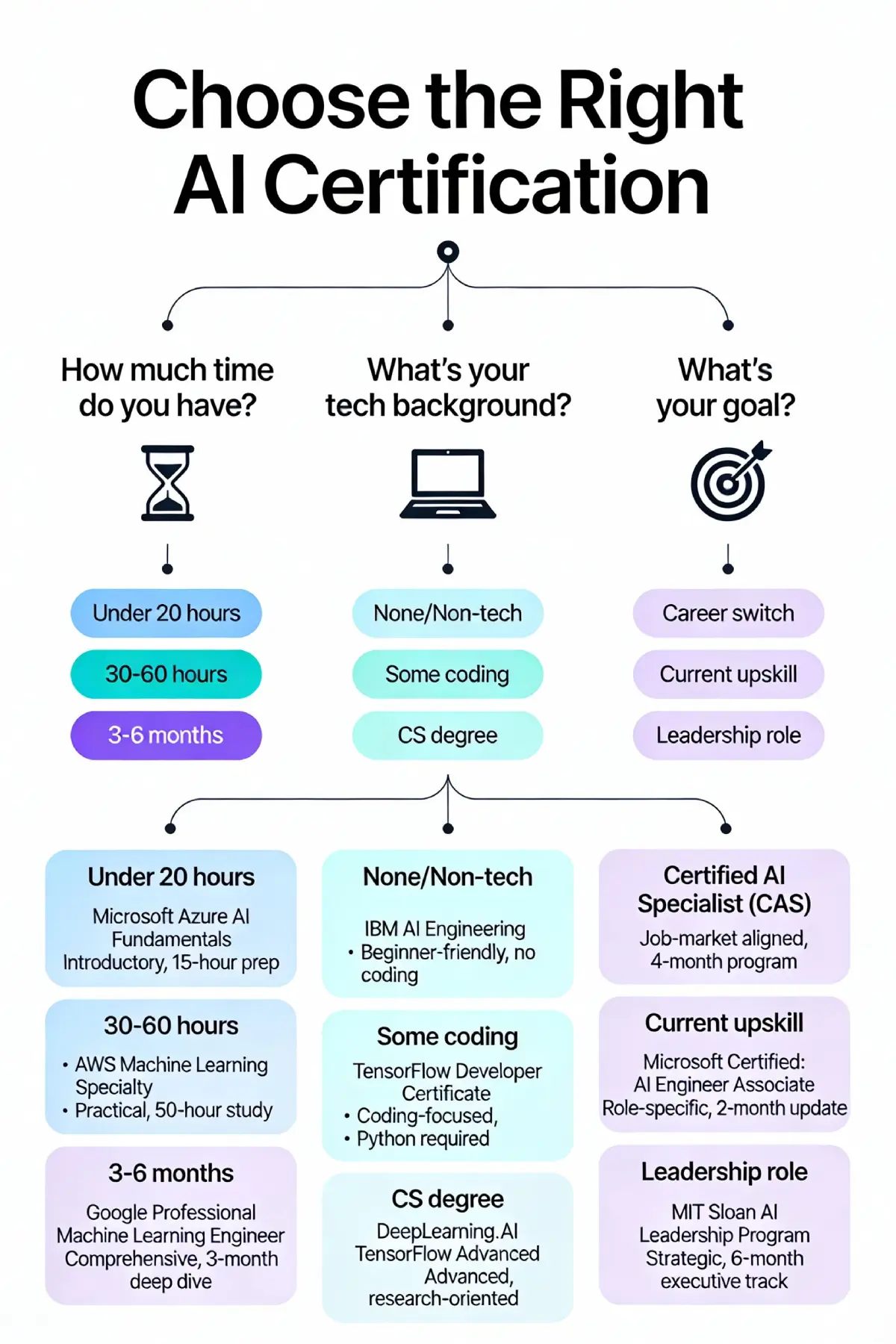
Use this simple flowchart to navigate to your ideal certification in 30 seconds:
→ Under 20 hours? → Tier 1
→ 30-60 hours? → Tier 2
→ 3-6 months? → Tier 3
→ 6-12 months? → Tier 4
Step 2: What's your job situation?
→ Career switcher needing new job? → IBM AI Engineering or Machine Learning Spec
→ Working, wanting upskill? → Microsoft Azure or AWS cert
→ Business leader, strategy focus? → AI for Everyone
→ Already employed, deep tech interest? → MIT or Stanford
Step 3: Can you commit to portfolio projects?
→ Yes → Go with choice from Step 2
→ No → Pick a tier higher (easier cert, less portfolio pressure)
Next Action: Don't overthink. Pick your certification, start Week 1, commit for the first month. If it fits, continue. If it doesn't, you've only lost a week—pivot quickly.
Your Next Steps: Getting Started
You've now got the complete picture. Here's your action checklist:
- Answer the 3 self-assessment questions (background, time, goal) - 5 minutes
- Pick your certification tier using the decision framework - 5 minutes
- Review the specific cert card for your choice - 10 minutes
- Sign up for free trial or free resources from your chosen program - 10 minutes
- Complete Week 1 (rough equivalent of 10% of program) to confirm fit - depends on cert
- If it clicks, commit fully - set calendar blocks, join communities, find accountability partner
- Plan your portfolio projects while learning - start Week 2-3
- Job search begins at Week 8-12 (don't wait for certification finish)