
Qual é a Inteligência Artificial mais poderosa em 2026?
GPT‑5.5, Claude Opus 4.7, Gemini 3.x and other frontier models are pushing AI to new heights. Here is how they compare, and what “most powerful” really means this year.

Resposta rápida: Não há uma única IA “mais poderosa” para tudo em 2026
In 2026 there is no single AI model that dominates every task. Instead, a small group of frontier models share the lead, and which one is “most powerful” depends on what you need it to do.
O que as pessoas geralmente querem dizer com “IA mais poderosa”
When people ask about the most powerful AI, they are typically referring to large, general‑purpose models that sit at the top of today’s benchmarks for reasoning, coding, and assistentes para atendimento ao cliente, suporte em reuniões e mais..
These frontier models are trained on vast amounts of data, have very large parameter counts, and are optimised to perform well across a wide range of tasks rather than specialising in just one thing.
Por que não há um campeão permanente
Vendors are updating their models at a rapid pace. OpenAI’s GPT‑5.5, Anthropic’s Claude Opus 4.7, Google’s Gemini 3.x and other frontier systems all launched or received major upgrades around the same period, and each new release can rearrange the rankings.
This constant iteration means that any claim about a single “best” model is only accurate for a brief window. What matters more is understanding how these models are evaluated and which one fits your use case.
Como Medimos a “Potência” na IA?
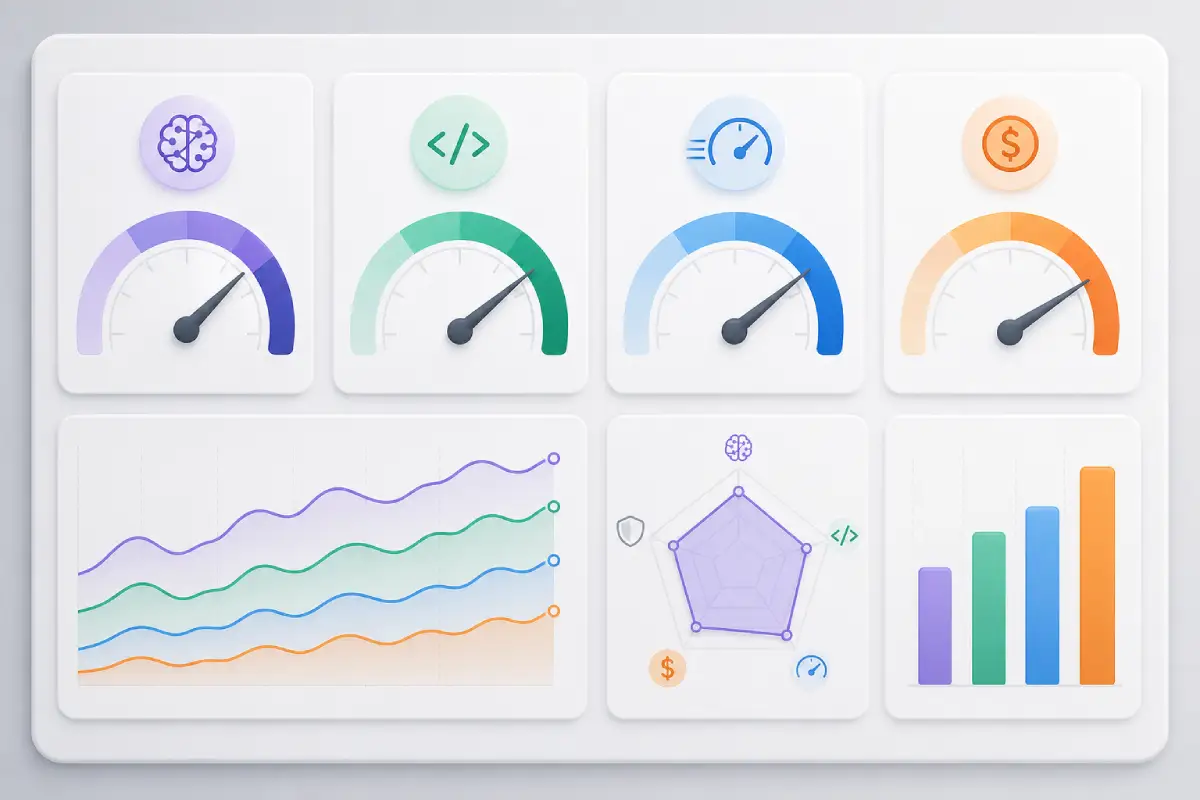
“Powerful” can mean different things: raw accuracy on tests, real‑world usefulness, speed, cost, or safety. Modern evaluations look at a mix of these factors instead of a single score.
Benchmarks e suítes de avaliação
Public benchmarks measure how well models handle tasks like exam‑style reasoning questions, complex tarefas de compreensão de leitura., math problems, and coding challenges simulated from real repositories.
On these benchmarks, the top frontier models often sit within a few percentage points of each other, forming a tight cluster rather than a single runaway leader.
Janela de contexto, ferramentas e agentes
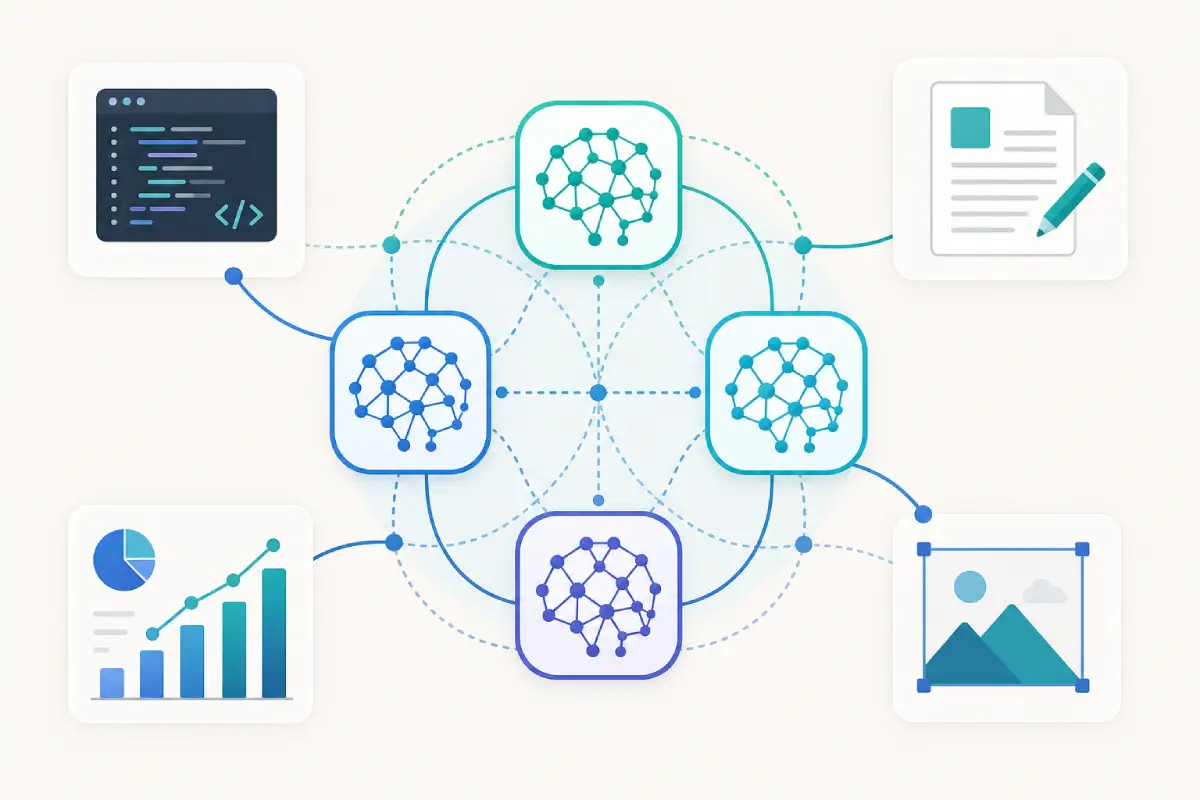
Beyond raw scores, janela de contexto size and tool use capabilities play a major role. GPT‑5.5, Claude Opus 4.7 and Gemini 3.x all support very long contexts, which allows them to work over entire codebases, long legal documents, or multi‑step workflows in one go.
These models can also call tools such as web search, code execution or custom APIs, and many are now used as “agents” that can operate software or carry out multi‑step plans under human supervision.
Confiabilidade, segurança e controlabilidade
In production, reliability and safety often matter more than the last few points on a leaderboard. Enterprises look closely at how often a model hallucinates, how well it follows guardrails, and how predictable its behaviour is across sensitive tasks.
Because of this, some teams prefer a slightly less aggressive model that is easier to steer and audit, even if another system scores marginally higher on raw tests.
Modelos de IA de fronteira: a elite em 2026
In 2026, several model families consistently appear at the top of independent leaderboards. Each has its own strengths and ecosystem.
Família GPT‑5 da OpenAI e GPT‑5.5
The GPT‑5 family, including GPT‑5.5, is designed as a general‑purpose workhorse. It performs strongly across reasoning, coding, writing, and chat and underpins many tools in the wider OpenAI and partner ecosystem.
For businesses already invested in earlier GPT versions, upgrading to GPT‑5.5 often brings better results without a complete rebuild of their stack, which helps cement its position as a go‑to choice.
Claude Opus 4.7 da Anthropic e a linha Claude 4.x
Claude Opus 4.7 sits at the top of Anthropic’s model range and is known for strong performance on challenging reasoning tasks, long‑document analysis, and careful handling of sensitive topics.
Many teams choose Claude for work that combines large context windows with a conservative, safety‑first behaviour profile, such as legal reviews, análise de políticas, and complex enterprise workflows.
Google’s Gemini 3.x Pro e modelos relacionados
Gemini 3.x Pro is built around multimodality and deep integration into Google products. It can work with text, images, video, and other data types in a single session and plugs into Search, Workspace, and cloud tooling.
For organisations heavily invested in Google’s ecosystem or in need of strong multimodal capabilities, Gemini is often the natural choice among frontier models.
Pesos abertos fortes e líderes regionais
High‑end open‑weights and regional models also compete closely on some benchmarks. While they may trail the very best closed models slightly on average, they can offer advantages in cost, customisation, deployment control, and data residency.
For teams that need to self‑host or fine‑tune models on private infrastructure, these open or regionally focused systems are an important part of the 2026 landscape.
A partir de 2026: Quais Modelos de IA Estão Realmente no Topo?
Leaderboards updated in 2026 show a narrow group of models trading places at the very top. The exact ordering varies by test suite, but the same names appear repeatedly.

O grupo de topo atual
Across public leaderboards, the highest positions are occupied by models such as GPT‑5.5, Claude Opus 4.7, top Gemini 3.x variants, and a small number of strong open‑weights that are competitive on specific benchmarks.
Rather than one clear winner, the pattern is a compact group of frontier systems that regularly trade first place depending on the test and scoring method.
GPT‑5.5 vs Claude Opus 4.7 vs Gemini 3.x
GPT‑5.5 tends to be treated as the best all‑rounder, combining strong reasoning, solid coding performance, and a mature tooling ecosystem.
Claude Opus 4.7 is often highlighted for particularly strong results on difficult reasoning, long‑context analysis and cautious behaviour in high‑stakes domains.
Gemini 3.x stands out for its multimodal capabilities, tight integration into Google products, and very large context windows for combined text and media workflows.
Por que os leaderboards discordam
Each leaderboard uses its own mix of tasks, weights, and evaluation methods. Some focus heavily on exams and academic benchmarks, others emphasise coding or independent human preferences.
Because of this, it is more accurate to talk about a top tier of models that consistently perform well across tests, rather than claiming that one model is definitively the strongest in every sense.
O que até a IA mais poderosa ainda não consegue fazer (por enquanto)
Even the best 2026 models have real limits. Understanding those limits is just as important as knowing where they excel.
Alucinações e raciocínio superficial ainda existem
Frontier models can still produce confident but incorrect statements, particularly when pushed outside their training distribution or asked about niche topics with little reliable data.
For critical decisions in areas like law, medicine, finance, or safety, human experts must remain in the loop to verify and contextualise AI‑generated outputs.
Sem objetivos reais ou compreensão
Despite impressive results, these systems do not possess consciousness, intent, or an internal model of the world in the way humans do. They recognise and generate patterns based on data but do not have personal goals or experiences.
That is why they can sometimes fail in ways that seem obvious to people, and why they need guardrails and supervision in real deployments.
Crescentes desafios de segurança e uso indevido
As models get more capable, the potential for misuse increases. The same skills that help legitimate users can also assist attackers, which is why safety, monitoring, and access controls are now core parts of frontier model deployments.
Organisations adopting these systems need governance as well as technical integrations, especially when they operate at large scale.
Como Escolher a IA “Potente” Certa para Seu Caso de Uso
Knowing which models sit at the top is useful, but the more important question is which one is right for your team, product, or workflow.

Comece pela sua carga de trabalho, não pelo hype
Begin by mapping what you actually need: is your main job writing and editing, coding and debugging, research and analysis, customer support, or building autonomous agents that operate other software?
Once you are clear on the job to be done, it becomes easier to evaluate whether you really need a top‑of‑the‑line model or whether a smaller, cheaper system will suffice.
Combine famílias de modelos com casos de uso comuns
As a rough guide, GPT‑5.5 is a strong default for broad, mixed workloads that lean on both reasoning and coding and benefit from a mature ecosystem of tools and integrations.
Claude Opus 4.7 is a good fit for long‑context analysis, policy‑sensitive domains, and situations where conservative behaviour and clear explanations matter.
Gemini 3.x is particularly attractive if you need deep multimodal capabilities or if your organisation is already heavily invested in Google’s cloud and productivity stack.
Considere custo, latência e integração
Raw performance is only one part of the equation. Pricing, request limits, latency, regional availability, and the ease of integrating a model into your existing systems can be just as important.
In many cases, it is better to use a “very strong” model that you can run reliably, affordably, and with good developer tooling than an absolute top performer that is harder to integrate or sustain at scale.
- Defina duas ou três aplicações principais onde um modelo poderoso ajudaria claramente.
- Prototipe essas aplicações com pelo menos dois modelos de ponta diferentes e compare os resultados.
- Considere não apenas a qualidade, mas também o custo, a velocidade e o quão bem cada modelo se encaixa na sua infraestrutura e requisitos de governança.