

Elicit
Un assistant de recherche IA qui recherche, résume et organise des articles académiques pour des revues de littérature plus rapides.
Mis à jour il y a 2 ans · vnull


Overview
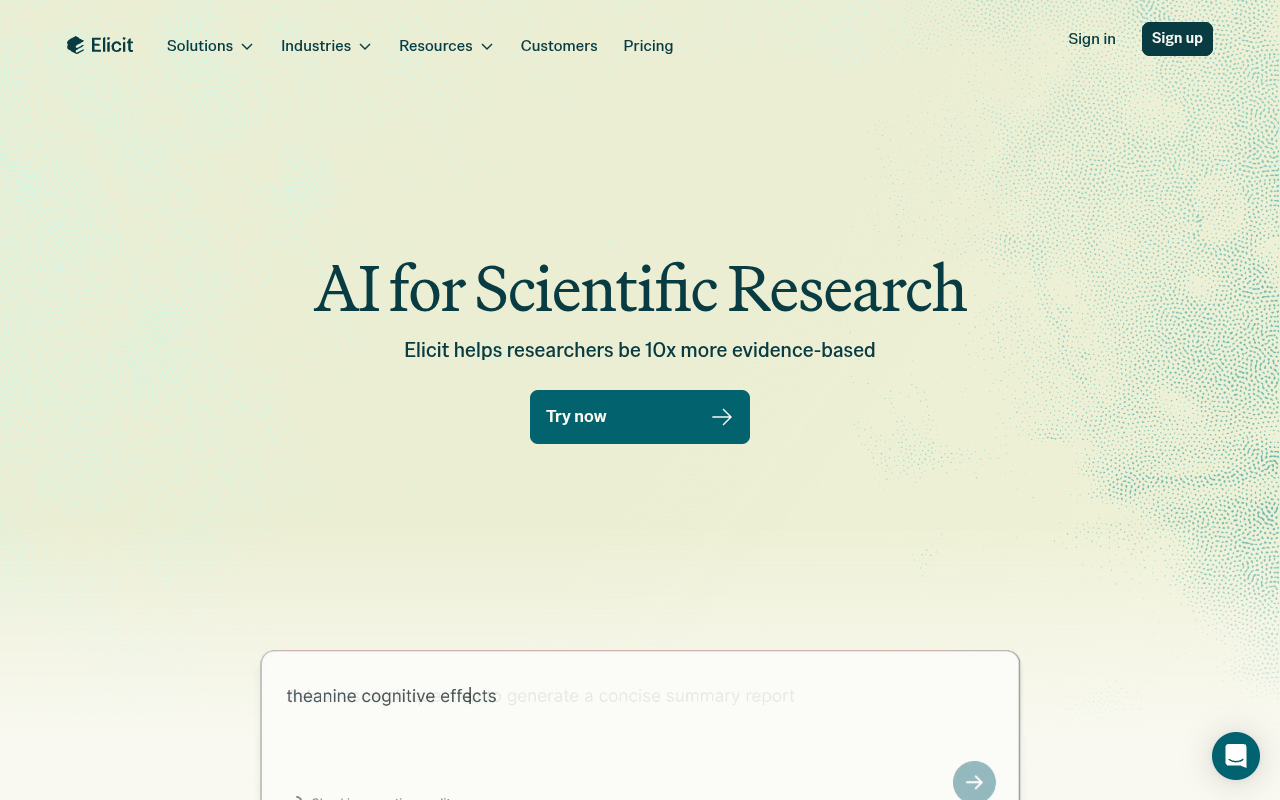
Elicit est un recherche en IA assistant that helps scientists and academics search, summarize, and organize academic papers. It uses recherche sémantique to find relevant studies from over 138 million papers and 545,000 clinical trials, then generates structured reports with citations. Researchers use it to speed up literature reviews and systematic reviews, claiming up to 80% time savings on screening and extraction de données.
Elicit is an AI research assistant designed for scientists, academics, and anyone who needs to navigate the vast world of academic literature. Instead of typing keywords into Google Scholar and manually reading dozens of abstracts, you can ask Elicit a research question and it will search over 138 million papers and 545,000 clinical trials. It then presents the most relevant results in a structured table with summaries and citations. The semantic search is a standout feature because you don't need to know the exact jargon to find what you need.
The tool is especially useful for systematic literature reviews, where it can automate the screening and data extraction phases. Users report saving up to 80% of the time normally spent on these tasks. Elicit also generates research reports that are customizable, so you can choose which papers and what information to include. The reports come with sentence-level citations, which is important for trust and reproducibility.
Pricing follows a freemium model. The free tier gives you basic search and limited reports, which is enough to test the tool. Paid plans start at $12 per month for more searches and longer reports. For heavy users, there is a Pro plan at $49 per month and enterprise options for institutions. The main downside is that the free tier is fairly restrictive, and the report customization options can feel overwhelming at first. But for researchers who regularly deal with literature, Elicit is a practical time-saver.
Key Features
Semantic Search
Finds relevant papers by understanding the meaning of your question, not just matching keywords.
Research Reports
Generates structured research briefs with citations that you can customize by selecting papers and data points.
Systematic Review
Automates screening and data extraction for systematic reviews, saving up to 80% of manual work.
Library
Saves and organizes sources into collections so you can reuse them across different projects.
Alerts
Notifies you about new research in your field without cluttering your email inbox.
API Access 3
Search papers and generate reports programmatically using the Elicit API.
Pricing Freemium
Gratuit
- Basic search
- Limited reports per month
- Support standard
749 $/mois
- More searches
- Longer reports
- Support prioritaire
Professionnel
- Unlimited searches
- Full report customization
- Accès API
Entreprise
- Intégrations personnalisées
- Support dédié
- Compliance features
Pros & Cons
Pros
- Searches over 138 million papers and 545,000 clinical trials in one place
- Semantic search finds relevant papers without needing exact keywords
- Generates structured reports with sentence-level citations automatically
- Automates screening and extraction for systematic reviews, saving up to 80% time
- Library feature lets you organize sources into collections for reuse
Cons
- Free tier limits how many reports you can generate per month
- Some niche or older papers may not be indexed yet
- Report customization can feel overwhelming for first-time users
Frequently Asked Questions
How does Elicit's semantic search work?
Elicit uses semantic search to understand the meaning of your query, not just match keywords. This means you can type a research question like 'Does theanine improve cognitive function?' and it will find relevant papers even if they use different terminology.
Can Elicit help with systematic literature reviews?
Yes. Elicit automates the screening and data extraction phases of systematic reviews. Users report saving up to 80% of the time normally spent on these tasks. It also supports PRISMA 2020 guidelines for reproducibility.
What sources does Elicit search?
Elicit searches over 138 million academic papers and 545,000 clinical trials. The team says more data sources are coming soon. It covers most major scientific databases.
Does Elicit provide citations for its claims?
Yes. Every AI-generated claim in Elicit reports includes sentence-level citations from the underlying sources. This makes it easy to verify the accuracy of the information.
Is there a free version of Elicit?
Yes. Elicit has a free tier that lets you search papers and generate a limited number of reports. Paid plans starting at $12 per month unlock more searches, longer reports, and Journalisation et événement accès.
Version History
Elicit introduced a paid tier with higher usage limits and priority features, moving from a fully free model to a freemium structure.
Elicit released a public API, allowing developers to integrate its research search and summarization features into other applications.
Elicit added support for extracting data from tables and figures within papers, expanding its analysis capabilities.
Elicit upgraded its underlying language model to provide more accurate and context-aware summaries of research papers.
69 Alternatives to Elicit

Aide académique IA
AI Essay Writer, Plagiarism Checker & Academic Tools
Aithor
Assistant d'écriture IA avancé pour l'excellence académique
Anara
Anara est un espace de travail IA pour les chercheurs afin d'organiser et...
Connected Papers
Visual exploration tool that maps related academic papers using citation...
Perspicace
Découvrez des articles académiques via des réseaux de citations.
Litmaps
Litmaps visualizes academic papers as interactive citation networks to help...Traffic Data
Traffic sources
Principaux pays
 États-Unis
70.1%
États-Unis
70.1%
 Allemagne
26.9%
Allemagne
26.9%
 Australie
3%
Australie
3%
Mots-clés principaux
Engagement metrics
User Reviews
Be the first to review Elicit
Please se connecter to leave a review.