NVIDIA presenta tecnologías de IA y GPU de próxima generación en CES 2025
NVIDIA, the powerhouse in graphics and AI technology, made a splash at CES 2025 with a series of groundbreaking announcements that promise to revolutionize computing, gaming, inteligencia artificial, and robotics. CEO Jensen Huang took center stage to unveil the company’s latest innovations, setting the stage for a new era of technological advancement.
Serie RTX 50: redefiniendo la tecnología GPU
fuente: Nvidia Youtube
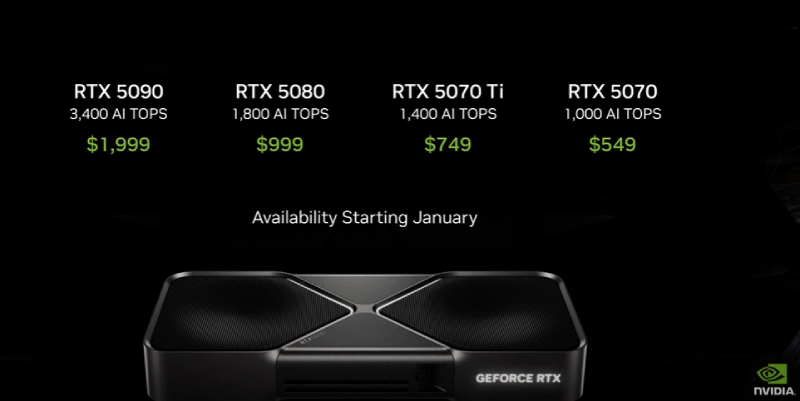
The spotlight of NVIDIA’s presentation was the introduction of the RTX 50 Series, powered by the new Blackwell architecture.
Esta próxima generación GPU family brings unprecedented performance and AI capabilities to both desktop and laptop computers.
La Serie RTX 50 cuenta con características impresionantes, incluyendo la RTX 5070 que ofrece un rendimiento similar al RTX 4090 por solo $549, y la RTX 5090 que proporciona el doble de rendimiento que el modelo 4090 anterior.
La serie integra cargas de trabajo de IA con procesamiento de gráficos por computadora, introduciendo innovaciones como compresión de texturas neurot y sombreado de materiales neurom.
NVIDIA ha logrado integrar estas potentes GPU en laptops, con el modelo de laptop 5070 que iguala el rendimiento de una 4090 de escritorio a un precio inicial de $1,299.
The future of computer graphics, according to Huang, is neuro rendering – the fusion of artificial intelligence and computer graphics.
Agentes de IA: el futuro de la computación empresarial
fuente: Nvidia Youtube
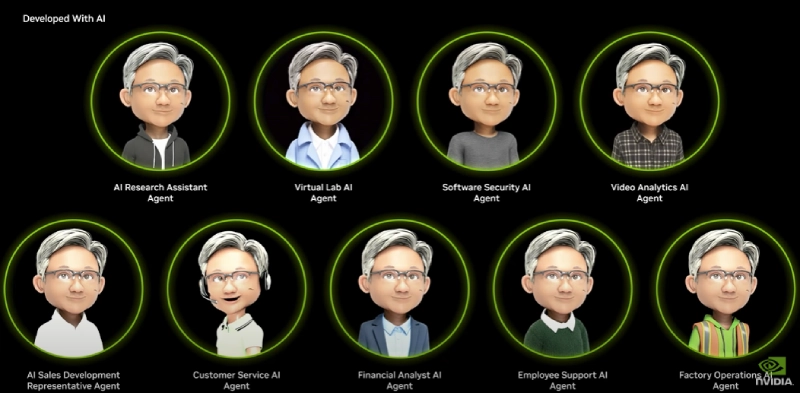
A significant portion of Huang’s presentation focused on IA agentica for aplicaciones empresariales. NVIDIA introduced three key components to help build agentic AI:
NVIDIA Nims: These are AI microservices packaged in containers, optimized for various applications such as vision, comprensión del lenguaje, speech, animation, and digital biology. These models can run in any cloud environment, allowing easy integration into software packages to create AI agents for various enterprise applications.
NVIDIA Nemo: Es un sistema digital de incorporación, capacitación y evaluación de empleados, diseñado para agilizar el proceso de integración de IA en los flujos de trabajo empresariales.
Llama Neotron Modelos de Lenguaje: NVIDIA announced a family of open-source language models based on Llama, fine-tuned for enterprise use. These models range from small, fast-response versions to ultra-large models capable of complex tasks. The Llama Neotron Suite includes models optimized for various enterprise applications, from quick interactions to complex problem-solving and even teacher models for training other AIs.
Huang enfatizó que estos modelos de IA are designed to be versatile and adaptable, capable of running in any cloud environment.
This flexibility allows for easy integration into existing software packages, enabling the creation of AI agents for a wide range of enterprise applications, from atención al cliente para análisis de datos complejos.
NVIDIA Cosmos: entendiendo el mundo físico
Quizás el anuncio más ambicioso fue NVIDIA Cosmos, un modelo de base mundial diseñado para entender el mundo físico.
Trained on 20 million hours of video, Cosmos focuses on physical dynamic things and has potential applications in robotics, generación de datos sintéticos, and physical scenario prediction.
Cosmos features an auto-regressive model for real-time applications, a diffusion model for high-quality generación de imágenes, and a unique tokenizer that learns the vocabulary of the real world.
When connected to NVIDIA’s Omniverse platform, Cosmos can provide physically grounded, truth-conditioned AI generations, opening up new possibilities for simulation and prediction in various industries.
Vehículos autónomos: conduciendo hacia el futuro
NVIDIA reafirmó su posición en la vehículo autónomo (AV) market with several key developments. The company announced partnerships with major automakers, including Toyota, for next-generation AVs.
También presentaron Thor, una nueva computadora robótica para vehículos con 20 veces la potencia de procesamiento de su predecesor.
Importantly, NVIDIA’s Drive OS has been certified to ASIL D, the highest standard of functional safety for automobiles, making it the first software-defined, programmable AI computer to achieve this certification.
Proyecto Digits: Supercomputación de IA en una forma compacta
The keynote concluded with the unveiling of Project Digits, NVIDIA’s latest AI supercomputer.
Este dispositivo compacto, impulsado por el chip GB110, promete llevar capacidades de supercomputación a los escritorios.
Construido en collaboration with MediaTek, Project Digits runs the entire NVIDIA AI stack and is expected to be available around May 2025.
El futuro de la robótica
fuente: Nvidia Youtube
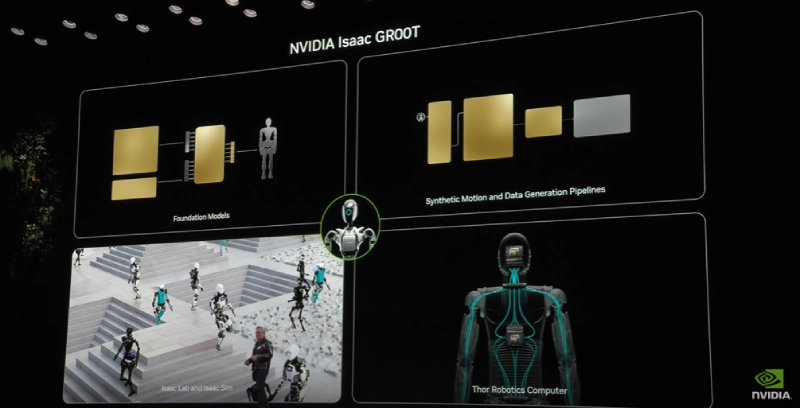
Huang also touched on the future of robotics, suggesting that the “ChatGPT moment” for general la robótica está a la vuelta de la esquina.
NVIDIA’s Isaac platform aims to provide technology elements to the robotics industry to accelerate the development of general robotics.
NVIDIA’s CES 2025 presentation demonstrates the company’s continued leadership in GPU technology and AI innovation. With advancements spanning gaming, enterprise AI, autonomous vehicles, and supercomputing, NVIDIA is poised to shape the technological landscape for years to come.
The focus on AI agents and the introduction of Cosmos and Project Digits highlight NVIDIA’s commitment to pushing the boundaries of what’s possible in AI and computing, promising a future where intelligent systems are more integrated into our daily lives than ever before.