NVIDIA stellt die nächste Generation von KI- und GPU-Technologien auf der CES 2025 vor
NVIDIA, the powerhouse in graphics and AI technology, made a splash at CES 2025 with a series of groundbreaking announcements that promise to revolutionize computing, gaming, künstliche Intelligenz, and robotics. CEO Jensen Huang took center stage to unveil the company’s latest innovations, setting the stage for a new era of technological advancement.
RTX 50 Serie: Neudefinition der GPU-Technologie
Quelle: Nvidia Youtube
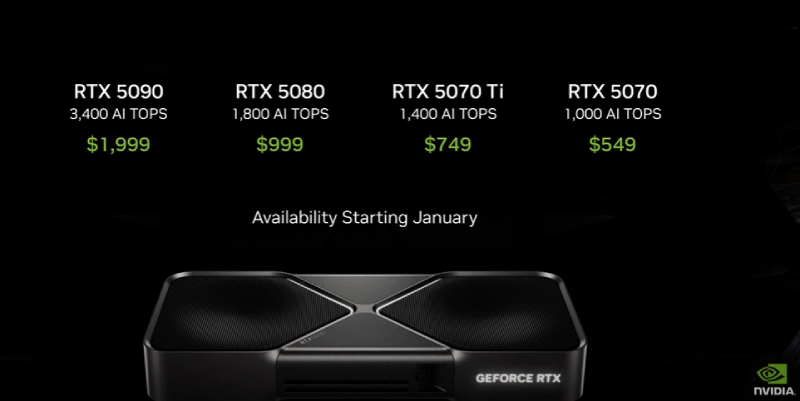
The spotlight of NVIDIA’s presentation was the introduction of the RTX 50 Series, powered by the new Blackwell architecture.
Diese nächste Generation GPU family brings unprecedented performance and AI capabilities to both desktop and laptop computers.
Die RTX 50 Serie bietet beeindruckende Funktionen, darunter die RTX 5070, die eine Leistung auf RTX 4090-Niveau für nur 549 US-Dollar bietet, und die RTX 5090, die die doppelte Leistung des vorherigen 4090-Modells liefert.
Die Serie integriert KI-Workloads mit der Computer-Grafikverarbeitung und führt Innovationen wie Neurot-Texturkompression und Neurom-Materialschattierung ein.
NVIDIA hat es geschafft, diese leistungsstarken GPUs in Laptops zu packen, wobei das Laptop-Modell 5070 die Leistung eines Desktop-4090 bei einem Einstiegspreis von 1.299 US-Dollar erreicht.
The future of computer graphics, according to Huang, is neuro rendering – the fusion of artificial intelligence and computer graphics.
KI-Agenten: Die Zukunft des Unternehmens-Computings
Quelle: Nvidia Youtube
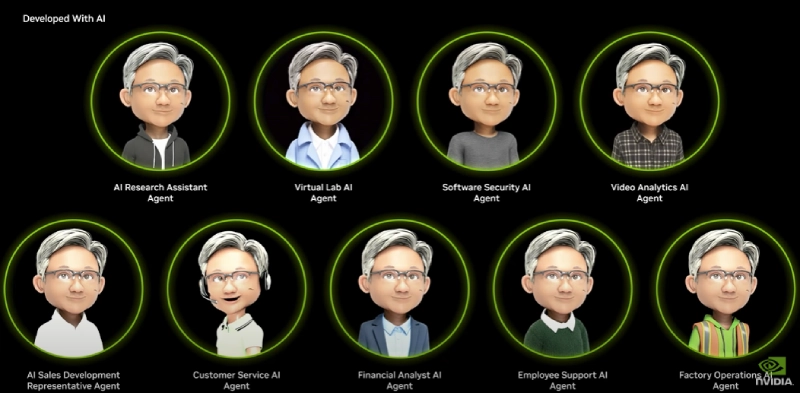
A significant portion of Huang’s presentation focused on agentische KI for Unternehmensanwendungen. NVIDIA introduced three key components to help build agentic AI:
NVIDIA Nims: These are AI microservices packaged in containers, optimized for various applications such as vision, Sprachverständnis, speech, animation, and digital biology. These models can run in any cloud environment, allowing easy integration into software packages to create AI agents for various enterprise applications.
NVIDIA Nemo: Dies ist ein System für die digitale Mitarbeitereinführung, Schulung und Bewertung, das den Prozess der Integration von KI in Unternehmensabläufe vereinfachen soll.
Llama Neotron Sprachmodelle: NVIDIA announced a family of open-source language models based on Llama, fine-tuned for enterprise use. These models range from small, fast-response versions to ultra-large models capable of complex tasks. The Llama Neotron Suite includes models optimized for various enterprise applications, from quick interactions to complex problem-solving and even teacher models for training other AIs.
Huang betonte, dass diese KI-Modelle are designed to be versatile and adaptable, capable of running in any cloud environment.
This flexibility allows for easy integration into existing software packages, enabling the creation of AI agents for a wide range of enterprise applications, from Kundenservice für komplexe Datenanalyse.
NVIDIA Cosmos: Das Verständnis der physischen Welt
Vielleicht die ambitionierteste Ankündigung war NVIDIA Cosmos, ein weltweites Grundmodell, das die physische Welt verstehen soll.
Trained on 20 million hours of video, Cosmos focuses on physical dynamic things and has potential applications in robotics, Generierung synthetischer Daten, and physical scenario prediction.
Cosmos features an auto-regressive model for real-time applications, a diffusion model for high-quality Bilderzeugung, and a unique tokenizer that learns the vocabulary of the real world.
When connected to NVIDIA’s Omniverse platform, Cosmos can provide physically grounded, truth-conditioned AI generations, opening up new possibilities for simulation and prediction in various industries.
Autonome Fahrzeuge: Die Zukunft des Fahrens
NVIDIA bekräftigte seine Position in der autonomes Fahrzeug (AV) market with several key developments. The company announced partnerships with major automakers, including Toyota, for next-generation AVs.
Sie stellten auch Thor vor, einen neuen Robotik-Computer für Fahrzeuge mit 20-mal so viel Rechenleistung wie sein Vorgänger.
Importantly, NVIDIA’s Drive OS has been certified to ASIL D, the highest standard of functional safety for automobiles, making it the first software-defined, programmable AI computer to achieve this certification.
Project Digits: KI-Supercomputer in kompakter Form
The keynote concluded with the unveiling of Project Digits, NVIDIA’s latest AI supercomputer.
Dieses kompakte Gerät, angetrieben vom GB110-Chip, verspricht, Supercomputing-Fähigkeiten auf Desktops zu bringen.
Eingebaut in collaboration with MediaTek, Project Digits runs the entire NVIDIA AI stack and is expected to be available around May 2025.
Die Zukunft der Robotik
Quelle: Nvidia Youtube
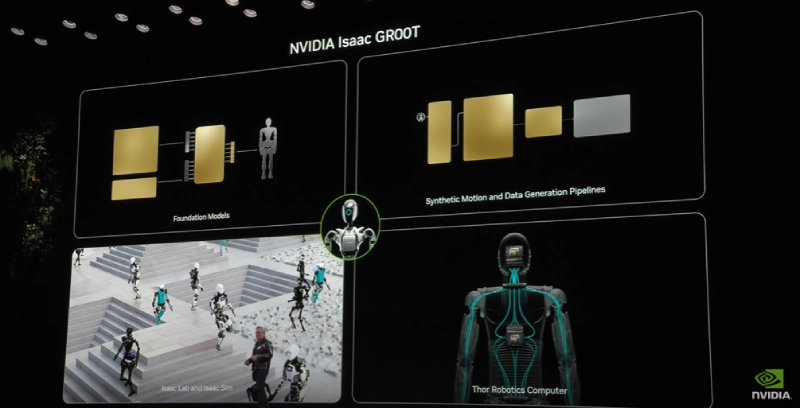
Huang also touched on the future of robotics, suggesting that the “ChatGPT moment” for general Robotik ist nur um die Ecke.
NVIDIA’s Isaac platform aims to provide technology elements to the robotics industry to accelerate the development of general robotics.
NVIDIA’s CES 2025 presentation demonstrates the company’s continued leadership in GPU technology and AI innovation. With advancements spanning gaming, enterprise AI, autonomous vehicles, and supercomputing, NVIDIA is poised to shape the technological landscape for years to come.
The focus on AI agents and the introduction of Cosmos and Project Digits highlight NVIDIA’s commitment to pushing the boundaries of what’s possible in AI and computing, promising a future where intelligent systems are more integrated into our daily lives than ever before.